
KAPITAL: The Japanese Brand That Broke Denim's Rules
Japan built its denim reputation on forensic accuracy. For decades the country's best mills competed to reproduce mid-century American jeans more faithfully than the Americans ever had.

KAPITAL learned that discipline, then walked away from it. The clothes coming out of its Okayama workshops are patched, over-dyed, stitched with visible thread and frequently funny. They look like artefacts from a history that never happened.
That is the point. KAPITAL is not a heritage brand. It is a brand that uses heritage tools to make things that never existed.
Website: kapital.jp
Where to find it: Fifteen stores across Japan, the official web shop, and stockists including Union Los Angeles, H. Lorenzo, Bodega and HAVEN
Breaking With Reproduction
The company was established in March 1985 in Kojima, a district of Kurashiki in Okayama, and the location is not incidental. Kojima is where Japan's first domestically produced jeans were made in 1965, and it remains the densest cluster of denim mills, dyers and cut-and-sew shops in the country.
Founder Toshikiyo Hirata encountered American vintage denim on a trip to the United States in the 1980s, where he was working as a karate instructor. He returned to Kojima, built a factory and mastered the reproduction of mid-century jeans. He died in April 2024.
His son Kiro studied art in the US and designed at 45R before joining the company in 2002. His ambition was blunt: his father had perfected the copy, so it was his turn to make something new, something built for the next hundred years.
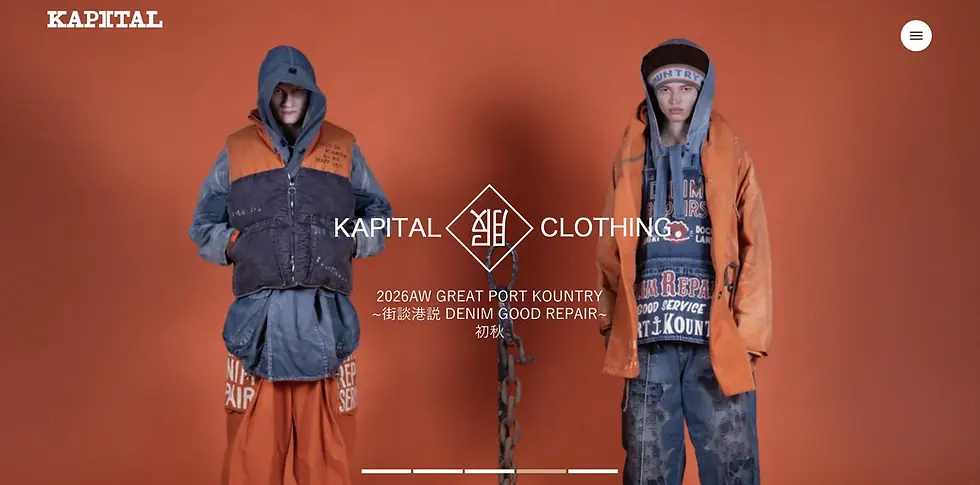
CENTURY DENIM is the clearest result, dyed with kakishibu persimmon tannin, with mud-dyed versions pushing it further from clean indigo. Denim is the spine rather than the whole body, though. The catalogue runs through coats, knitwear, sweats, bags and shoes, and bandanas are enough of a fixation that the brand keeps a museum of them in Kojima. The same logic runs through the brand's boro and sashiko work, where cloth is patched and re-stitched the way rural households in northern Japan once did out of necessity, and later carried a stigma for. KAPITAL titled a 2024 collection Beautiful Boro Borough, and at its BORO POWER FOR PEACE exhibition that August it handed visitors needles to stitch its own boro fabric, then had a KOUNTRY craftsman rebuild the collective work into a single jacket.
How Kapital Actually Reaches People
KOUNTRY is the remake sub-line, where garments are distressed, reconstructed and embroidered until the original category stops mattering. Limited KOUNTRY pieces are released on the second Sunday of each month, at undisclosed stores. No announced location, no raffle, no queue to join.
In a drop economy built on countdowns, that is close to heresy. It also works, because the scarcity is real. Every reconstructed piece is different, and labour sets the ceiling.
The rest of the model is just as unhurried. Fifteen stores, all in Japan and none overseas, with a headquarters in a former public library the family bought in 2013, and production running through four sewing factories and the brand's own dyeing works.
The following arrived anyway. A$AP Rocky, John Mayer and Shai Gilgeous-Alexander wear it, and David Sedaris gave it a New Yorker essay in 2016, describing clothes that look as though their previous owner was thrown off a boat.
What happens next is the open question. In January 2025, WWD and Business of Fashion reported that L Catterton, the private equity firm backed by LVMH, had taken a majority stake at the end of 2024. Terms were not disclosed. Nothing about the way KAPITAL makes clothes is efficient, and that inefficiency is precisely what people are paying for.
Follow Minecolabs for more drops and dispatches.


